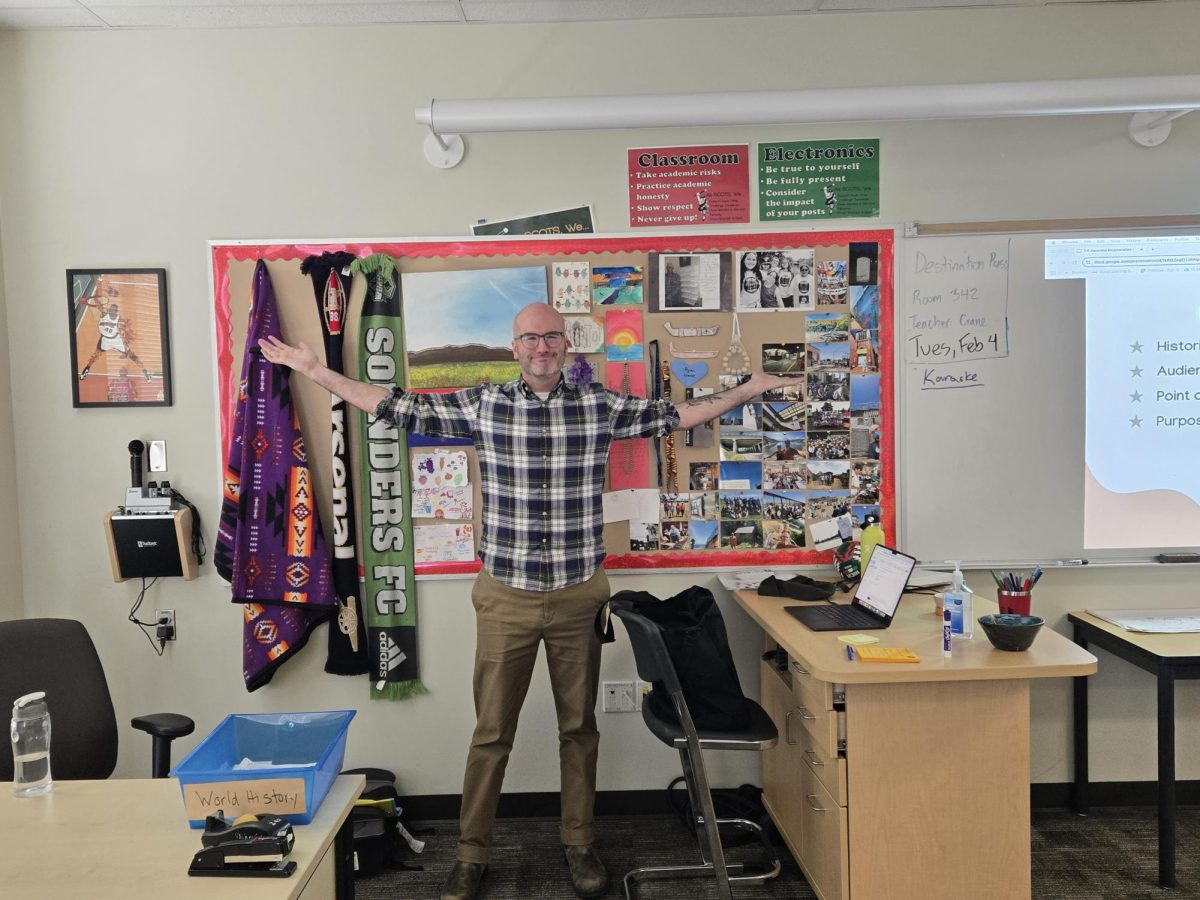


For many students at Shorecrest, Mr. Peterson is a familiar face in the English/Language Arts department, having guided dozens of classes through literature and writing for nearly a decade. Sitting down in his familiar classroom, room 351, during third period on October 16, 2025, he revealed that his path to teaching was not a straight line, but an evolution that began with a very different career in mind.
“I totally evolved into teaching,” Mr. Peterson explained. “I didn’t plan on becoming a teacher when I was young, especially not in high school. I always saw myself as a musician and wanted to become a musician.” After realizing a professional music career as a guitarist or bassist might not be a sustainable or healthy career path, he had what he called an “epiphany”. Coming from a family of teachers, he decided, “I should just go into teaching.”
Interestingly, English wasn’t Mr. Peterson’s first choice of subject to teach. “When I first went into teaching, I was probably more focused on science. And I was also working with younger students. So that was kind of my jam at the very beginning of my career.” Now in his ninth year at Shorecrest, his journey included a 30-year career teaching at the elementary level, where he also served as a counselor and specialist. His transition to Shorecrest came when it was time for a change. “English was what my major strength was at that point,” he said, “and so that’s the job I applied for.”
When it comes to his classroom philosophy, Mr. Peterson’s goals go far beyond the curriculum. The most important lesson he hopes to impart has nothing to do with grammar. “What I want students to take away is… a feeling of self-confidence and just knowing that they have the ability to do what they want to do.” His main objective is to ensure students leave his class feeling empowered. “I know that they’re learning English, they’ll learn the things that they need to learn. And I want to make sure that they get through this high school experience feeling good about themselves and feeling like, ‘I can do this, I can do that, I can do a lot of different things’, and that they have the confidence to know that.”

This philosophy also directly informs the English curriculum, as seen in the eleventh-grade unit on the Young Adult novel Firekeeper’s Daughter (2021). When we discussed the book choice, Mr. Peterson said, “It’s a good book. It has an interesting character, and it touches on a lot of current issues about drug issues and relationship issues, indigenous people, lots of different things that are worth talking about. And then it just does a really great job of helping us track a character, a person who’s going from their childhood into the adult world and having to make choices about college and work and all those kinds of things.”
As I had taken his English 11 class last year, I asked him whether there was any alternative or classic literature the English department could have chosen to dissect. Although Mr. Peterson himself adores classic American literature, he maintained that relatability is a key factor. “I have students who are new to this country, students who have been here all their lives, students who come from this family or that, or this culture or that. And so we try to find things that help provide them with things that they can identify with.”
When asked about the new cell phone policy, Mr. Peterson had this to say. “I do think it’s working. First of all, I don’t really have to deal with it at all anymore, like last year. So it’s reduced conflicts around that hugely. I get a sense that a lot of students feel kind of relieved about that. The conflict is taken away from them too, and also the distraction. And I think a lot of students are grateful for that. I know that some students, you know, get frustrated if they can’t whip out their phone and use it like they normally do. But it’s pretty rare.”
Everything has two sides, even well-meant school policies. As a full-time Running Start student, I had close to no idea what the policy is like for students, let alone teachers. Mr. Peterson provided some valuable insight into the challenges the faculty members have faced since September. “You know, we try to create this school-wide policy. Then probably the biggest challenge is not the students (complying), the biggest challenge is that every adult understands the policy and honors the policy with fidelity. And then they stick to it. And what we find is that it’s really hard because there’s a lot of teachers who still may feel uncomfortable or may not agree with it or are not clear about it. So, we, the teachers, need to keep working that out.”
The most rewarding part of his job, he shared, is “always the students. Always the positive interactions with students. Being able to connect with kids, either around school or just about life, is incredibly rewarding.” He finds deep fulfillment in helping students navigate through both academic and personal challenges, which I can personally attest to. He then continued on with, “I love English, and when I’m teaching English, I’m all English, but there are just so many other dynamics of being a teacher and working with high school students and teenagers at that point in their life that go way beyond the subject.”
On the flip side, the greatest challenge is managing conflict. “I just really struggle with conflict,” he admitted. “If I have a negative interaction with a student, it wipes me out. And I try to mitigate that as much as I can.” He also noted the difficulty of teaching a compulsory class that isn’t necessarily everyone’s favorite. “There’s a lot of students here who might not like English, and that can be kind of hard because I love the subject and I like to be positive about it. And so, I have to figure out ways to help that, help my students to feel positive about it, even if they don’t want to be here.”

When asked for a book recommendation, he acknowledged the fact that there are too many good books out there and there’s no one book that does it all. But after a few moments, he came up with The Crucible (1953), a personal favorite of mine as well. “It’s a dark story, it’s short, it’s a play. But it is so applicable to life right now. And it just brings out so many of those deep character flaws that humans have. And it’s so rich with possible discussions about them. It’s not probably the most enjoyable book to read, but I think it has a lot of meaning.”
Mr. Peterson remains content in a role he finds so rewarding, a role that has always been about much more than the subject matter. His goal of building students’ self-confidence is a lesson that has undoubtedly resonated with hundreds, if not thousands, of students he has taught over the years, leaving a lasting mark on the Shorecrest community and beyond.