

Have you ever had a ladybug land on your shoulder and had good luck for the rest of the day? I guess there is a reason they are one of the more popular bugs found in the autumn season. But along with them comes their much more invasive cousin, the Asian lady beetle. They might look very similar to each other, but being able to spot the difference could save your garden, or your house, this fall. Here is a guide on both bugs, along with how to tell if you’re looking at a lucky ladybug or a harmful imposter.
The Asian Lady Beetle
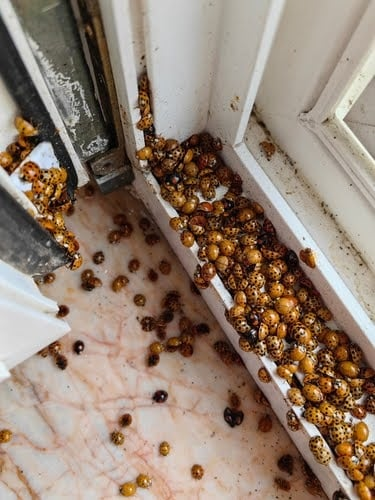
This little critter may look charming and whimsical because of its bright colors and fun pattern, but in reality, it is a deadly invader. Deadly to plants, that is. They are native to East Asia, but were brought to North America for pest control, but quickly became a nuisance themselves. The Asian lady beetle starts by feeding on harmful garden pests, or other plant-eating insects, which may sound like a good thing. The problem arises when they don’t leave once the gardening season is over, and instead, they swarm. These insects tend to crowd on reflective surfaces such as windows or sliding glass doors, and they will invade your home if given the chance.
Asian lady beetles are typically drawn to the sunny side of larger buildings, and buildings near a forest or wooded area are more likely to attract the insects. They fly to these places in late September to late October, where they swarm and promptly crawl into small cracks and gaps around the structure, looking for places to spend the winter. Many die during this time, but just as many live. Far too many in my opinion. They then come out during the spring to continue their invasion of your gardens and homes.
If you encounter an Asian lady beetle in the outdoors, or if they have managed to invade your home (I’m sorry), there are a number of unsettling things they do. Don’t worry, they don’t carry disease, they don’t really damage property, and they can’t sting. Although, what they can do is just as unsettling, in my opinion. When they feel threatened, they secrete a foul-smelling yellow liquid from the joints of their legs. This can stain light-colored surfaces, but mostly it smells absolutely terrible. This also happens when they are crushed, and it is called “reflex bleeding.” While the most reflex bleeding can do to humans is trigger allergies, if it is swallowed by a pet, it could do serious harm to the pet’s mouth, stomach, and esophagus. Also, while they cannot sting, they can “bite” by scraping the skin they land on, which could be hard enough to break the skin.
Another fun fact about Asian lady beetles: they are often found in wine grape groves, where they contaminate the grapes and make them unsafe to eat.
Are Ladybugs Just as Bad?
While they may look the same, Asian lady beetles and ladybugs are actually very different. While Asian lady beetles swarm in large numbers to find shelter indoors, ladybugs prefer to find shelter alone and outdoors. As mentioned before, both insects feed on plant-eating bugs, mainly aphids. A ladybug can eat as many as 5000 insects in its lifetime, and this makes them a blessing to farmers. They also secrete a liquid from their leg joints when threatened, but it comes with zero odor and is much less dangerous to pets.
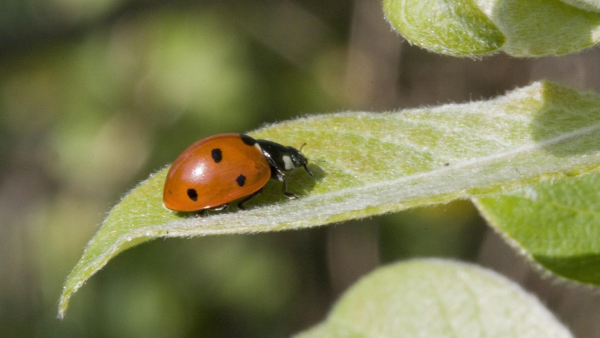
There is a reason ladybugs are known to be lucky after all. It is likely that myth originated from farmers spreading the word of how helpful ladybugs are for crops. They are like a natural form of pest control. That, combined with the fact that ladybugs are often linked with the Virgin Mary in Catholicism, shows how word spread about the luck of ladybugs.
Spotting The Difference
The main way to spot an Asian lady beetle is to look at the ‘M’-shaped marking on its head, as is shown in the picture. This marking could be thick, or it might be thin and broken up. Either way, the ladybug does not have this marking, making it the best way to tell which is which.
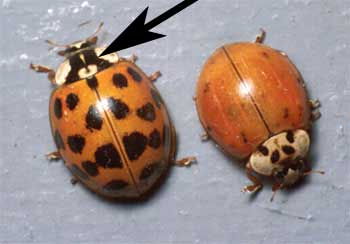
There are other ways of course, if it is too hard to make out the bugs head, or you are unsure of whether it is an M or not. The Asian lady beetle has a more oval-like body shape, compared to the rounder, dome-shaped body of the ladybug. While you’re looking at the shape, also look at the length, as ladybugs are normally a couple of millimeters shorter. Asian lady beetles’ spots are inconsistent in amount, size, and shape, while ladybug spots are more uniform. They could have up to 24 spots, but the most common varieties in Washington state are 7 or 12 spots.
Conclusion
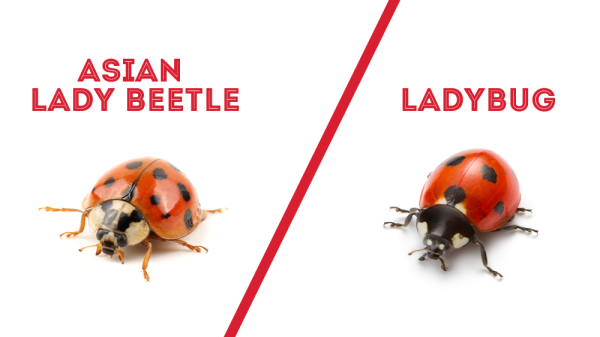
As you can see, there is a large difference between the ladybug and the Asian lady beetle. While the latter does not give off the cozy fall vibes you might be wishing for, it is definitely still interesting to see what they can do. So long as they stay away from my house, and my pets, I believe they are a very nifty little bug to know about. I hope you had as much fun learning about them as I did!