



Spoiler warning!!
For those of you who don’t know, Hadestown is a musical. I saw it last year, and not to be dramatic, but it changed my life. Hadestown was created by Anaïs Mitchell, and it is the story of the Greek tragedy Orpheus and Eurydice, told by the Greek messenger god, Hermes. There are many different versions of the story, as it has been told and retold over hundreds of years, but the general story is that Eurydice gets taken to the underworld and held there by Hades, the god of the dead. Orpheus soon realizes this and follows after her, since they are in love. Hades tells him that to get Eurydice back, he must walk back out with her following him, but if he turns around to check that she is there, she will go back to the underworld forever. It seems straightforward, right? But Orpheus does turn around, and Eurydice is lost for good.
There are many different reasons people come up with for why he turns around, and I will touch on why I think he does it later in this article. All you need to know is everyone watching this musical goes into it knowing it’s a tragedy. This leads me to my first point.
The Beginning
Would you watch a movie with a major plot twist if you already knew what that plot twist was? I would assume the answer is no. But that’s where the magic of Hadestown is. Within the first couple of songs, Mitchell gets you so immersed in the world and the characters, that you somehow manage to forget how the story ends. And if you do remember, you still feel hope for them, you still think there is a possibility that the story could end differently.
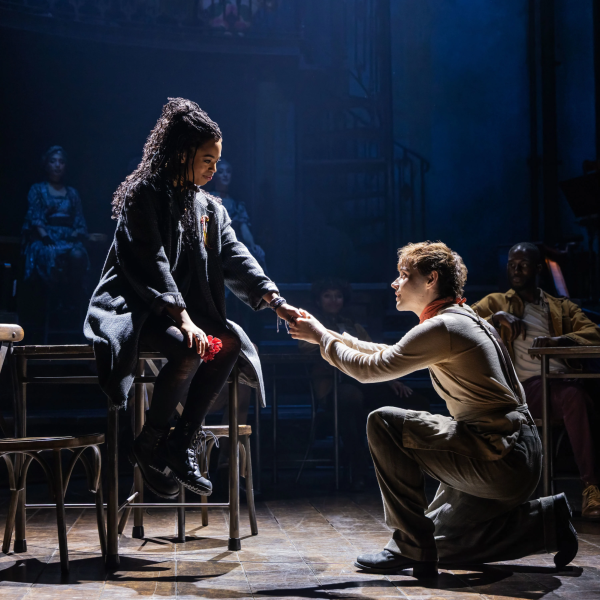
The story starts with Hermes introducing all of the characters, gods and humans alike, along with how Orpheus and Eurydice first meet. This also sets the scene of a broken world, where “it’s either blazing hot or freezing cold” (Any Way the Wind Blows). The musical specifically takes place on the railroad track to the Underworld, also known as Hadestown. Hermes tells us how Eurydice has spent her whole life on the road, but then she meets Orpheus. They fall in love and he convinces her to settle down and stay with him.
Their love story is told beautifully, showing how much hope Orpheus gives Eurydice that the world can change. He does this through his music, and throughout the whole show he is working on a magical song that will fix what’s broken in the world. Hermes tells us he is able to “make you see how the world could be, in spite of the way that it is” (Road to Hell Reprise).
This is the main theme in the musical, hope. Orpheus is the personification of hope, and also what happens when you lose it. This is why his and Eurydice’s love story is so compelling. It shows us this girl, down on her luck, who is finally given a piece of hope. But Orpheus and Eurydice’s relationship is not the only love story in this musical.
Hades & Persephone
If you have heard the myth about Hades and Persephone, then you know that in the end Persephone gets to spend six months of the year in the overworld, and the other six with her husband in the underworld. When Hadestown takes place, it is clear that this has been going on for a while, and every year Hades comes to get her earlier and earlier. It is clear Persephone does not appreciate this, as she loves being around her people of the overworld, and she especially does not appreciate the empire Hades has been building in the underworld.
Anyone who is willing to essentially sell their soul to Hades will then spend the rest of their life mining and building for him. It is said that he does this to drown out the loneliness and doubt he feels when his wife is gone, as he is scared she will never come back. He is driven by these feelings, and also greed, to have his workers build a wall around his riches, around Hadestown. He also keeps collecting workers, who are suffering in the world above, and makes them a deal to come work for him. This is how he finds Eurydice, because even though she’s married to Orpheus, they are still struggling to survive. While Orpheus is working on his song to fix the world, and is blocking everyone he knows out, he makes her a deal she can’t resist. And so she joins the workers in building the wall around Hadestown.

When Persephone returns she is not impressed, but it is clear she has less power in the underworld. She fades into the background more, and this change is shown in the bright green dress she wears in the overworld compared to the simpler black one she wears in the underworld.
Their relationship creates the perfect metaphor, with Hades representing man and Persephone representing nature. The two used to be close, but now nature is kept contained and far away from man.
As the musical progresses and Orpheus learns more about their story, he realizes, “the gods have forgotten the song of their love” (Chant). Orpheus wants to set the world right, and he realizes to do this he must help Persephone and Hades realize what went wrong, how it used to be. This is one of his main motivations throughout the show, but there is another one.
Getting His Wife Back
Although Orpheus wants to change how the world is, when Eurydice goes away, he is driven purely by love to go down to Hadestown and get her back. Watching the musical, it is easy to mistake Orpheus as weak, simply because he always follows his heart and not always his brain. But the thing is, his heart is strong, and this is shown in his journey to the underworld. He can’t take the train, he has to walk, a path Hermes tells us is not for the faint of heart.

This journey changes him. It makes him come face to face with the worst the world has to offer, something he has never done before. It does make him more determined, but we can also see that he is scared, which will come back to haunt him when he is walking back with Eurydice.
Once he gets to Hadestown, he finds Eurydice and tells her he’s going to take her home. She immediately runs into his arms, but then tells him that she’s trapped there, since she signed a deal with Hades. They are both heartbroken, and in his heartbreak Orpheus sings a song about losing his love and the cruelty of the world. This touches the hearts of everyone, the workers, Persephone, and Hades. Hades decides to let Orpheus sing one last song before he sends him away.
Orpheus sings a song of the story of Hades and Persephone, showing Hades how in his efforts to keep his wife with him, they have actually gotten farther apart. This one song, this sense of hope, makes Hades and Persephone finally see what went wrong. Orpheus then asks if he could leave with Eurydice, and Hades says yes, but on one condition.
Turning Around
As they walk back to the overworld, Eurydice must walk behind Orpheus, where he can’t see her unless he turns around. But if he turns around, she will be sent back to Hadestown forever. He can’t hear or see her at all; he simply has to trust she is there.
Now, I believe that if the Orpheus from the beginning of the show had been in this situation, he would not have turned around. But during his journey to the underworld, Orpheus learned how to doubt, which is all he does as they walk. He doubts that Hades would let them go that easily, he doubts that Eurydice would trust him to lead her home, he doubts in himself most of all, in his ability to not look back.
He does, though. Of course he does. He loves her too much to do anything else. After Orpheus turns around, the two lovers share a look of raw emotion before Eurydice is swept back underground and Orpheus is left alone.
After seeing this, a lot of people might think, why? Why go through this whole story about love persisting in a cruel, harsh world, only to have it end in a tragedy? This is because Anaïs Mitchell is asking you to think, what if. What if the story hadn’t ended that way? What if they both made it out together? Ending the story with that sense of hope, the one that Orpheus always had, is so much more powerful than simply handing us a happy ending.
In the beginning and the end, Hermes tells us, “It’s a sad song, but we sing it anyway” (Road to Hell). He’s telling us that seeing this sad story, this tragedy, and believing it could be different one day, is extremely important. Because that hope is what will get us our happy ending.







Linnaea • Dec 20, 2025 at 10:53 am
absolutely love it <3