


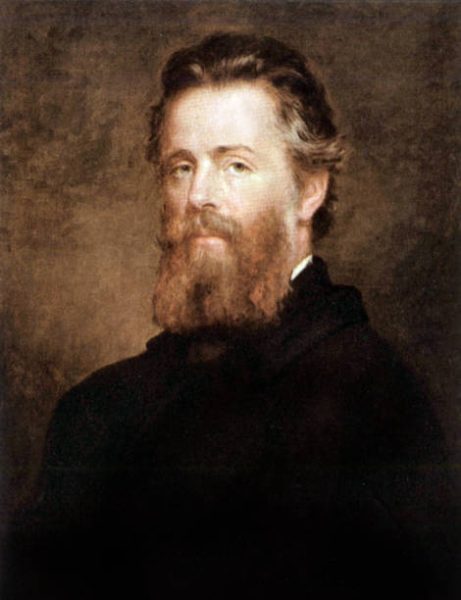
In the wake of the COVID-19 pandemic, terms like “The Great Resignation” and “Quiet Quitting” dominated headlines and described a workforce disillusioned with the culture that demands a person’s life revolve entirely around their job. However, this sentiment is not unique to the 21st century. Rather, it is a recurring system of industrial labor. One of America’s greatest writers, author Herman Melville, explored these issues in his 1853 short story, Bartleby, the Scrivener: A Story of Wall Street. Written during the rise of American financial dominance, he examines the crushing weight of office labor through the eyes of a boss (The Lawyer) and his misunderstood employee (Bartleby). By analyzing the story alongside modern economic trends and norms, we can see that the struggle for human dignity and agency in the workplace has been a historical constant. While Bartleby, the Scrivener was originally published to critique the sterile, isolating, and dehumanizing environment of emerging 19th-century Wall Street capitalism, the story has profound relevance for modern-day readers. Specifically, the story reveals the persistent nature of workplace alienation, the ethical limits of employer responsibility, and the unnerving power of passive resistance in a conformist system.
The alienation in Melville’s story is rooted in the mechanical, soul-crushing nature of the work itself. The scriveners (someone whose job involves writing documents or dealing with written documents) are tasked with mind-numbing copying, a form that is not creative, meaningful, or productive in any sense, which essentially turns the worker into a human duplicating machine. In Melville’s time, this was a physically exhausting task, requiring men to hunch over desks for ten to twelve hours a day, staring at legal documents until their eyes failed them. In this environment, Bartleby and his coworkers aren’t valued for their individual minds or potential, but only for their daily output at the workplace. They are interchangeable parts in a legal machine. This 19th-century depiction of dull and wearisome labor mirrors the disengagement that modern workers of the 21st century still experience, even if their “copying” now takes place on an Excel spreadsheet. Just as a human being was reduced to a hand holding a pen, the modern data entry worker is often reduced to a set of keystrokes and is completely disconnected from the final product of their labor.
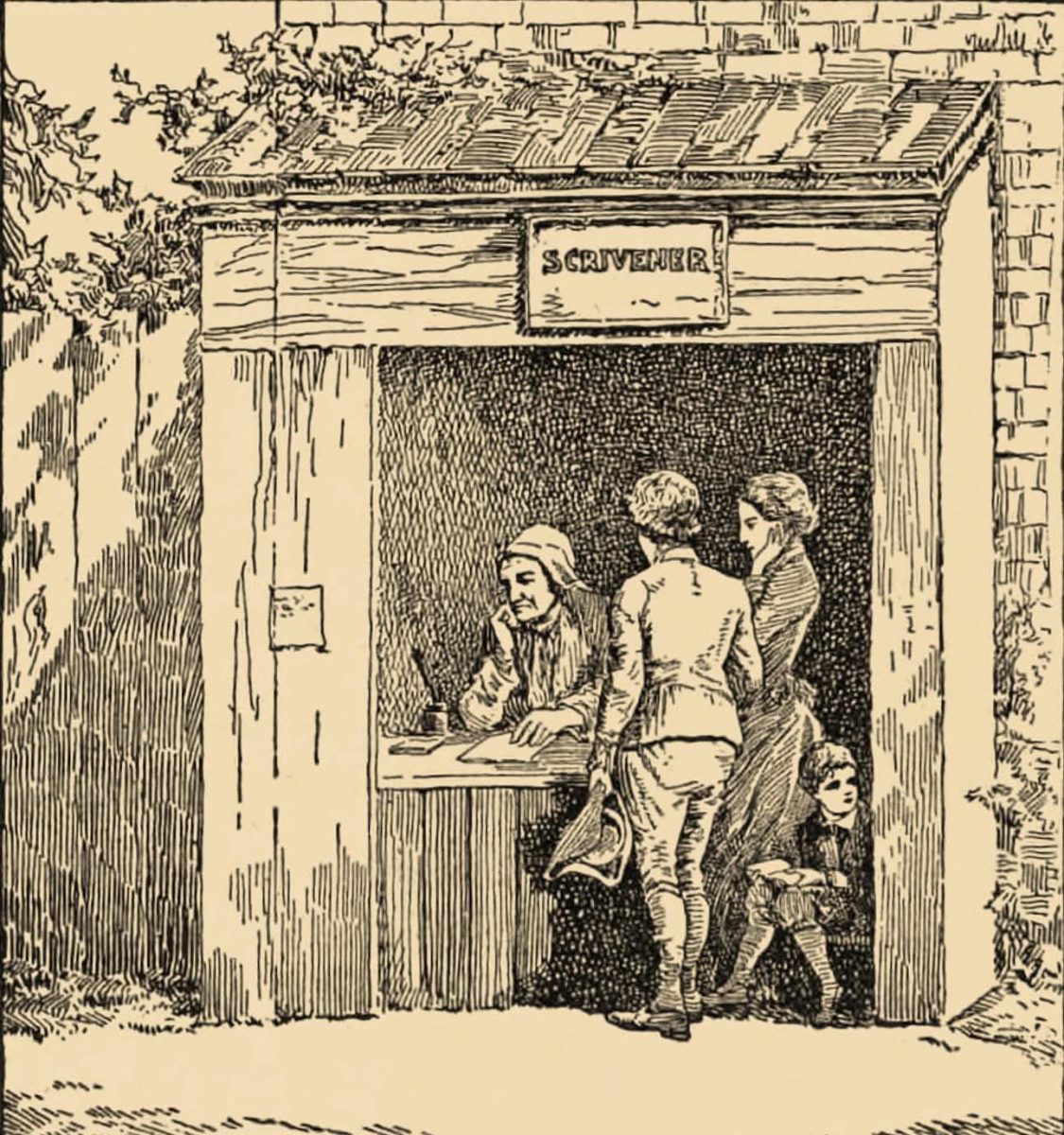
Beyond the actual work, the environment described in Melville’s Wall Street office presents a significant challenge for the workers, which symbolizes both social and psychological isolation. The Lawyer describes his area of focus as, “my windows commanded an unobstructed view of a lofty brick wall, black by age and everlasting shade,” while Bartleby’s window faces another “dead-wall” just ten feet away (Melville). These walls do not just act as physical barriers; they are symbols of confinement, a lack of perspective, and a bleak career path. The sheer physical closeness of the brick walls implies that the workers are “trapped” together, cut off from the city and civilization altogether. This setting highlights a social failure of the workplace, as it creates a barrier between employers and workers that allows for commands and instructions yet prevents any possibility of genuine communication.
Bartleby and his boss aren’t the only ones in this stifling environment. Their coworkers, Turkey and Nippers, demonstrate how the workplace crushes the human spirit in different ways. Turkey, a productive and hard worker in the morning, becomes drunk, cranky, and almost useless in the afternoon. On the other hand, Nippers, suffers from “indigestion” and irritability in the morning and constantly adjusts his desk due to his physical discomfort. The two characters do a kind of changing of the guard at lunchtime, and they represent the biological rejection of their work conditions. Through both nervous energy and physical ailment, their bodies are rebelling against the monotonous work. However, unlike Bartleby, they continue to participate in the system, channeling their misery into erratic behavior rather than flat-out refusal. Turkey and Nipper are the “functioning” burnt-out employees who complain but comply, whereas Bartleby represents the total system failure of the modern worker who simply stops functioning altogether.
The most profound challenge to Melville’s 19th-century workplace comes from Bartleby’s iconic refrain, “I would prefer not to.” This simple and polite phrase acts as a form of passive resistance that baffles his fellow coworkers and boss. The Lawyer is prepared for anger, for laziness, or for incompetence, but he is not prepared for a calm refusal of the premise of work itself. By refusing to proofread or run errands, Bartleby breaks the cycle of command and introduces a unique variable the faulty system cannot handle. His refusal is more than just stubbornness, it represents a tired worker’s desperate attempt to reclaim agency in an environment designed to strip it away. It is a protest that forces the employer to confront the fact that his power over his employee is an illusion, held together only by the employee’s willingness and motivation (work benefits, salary, etc.) to play along.
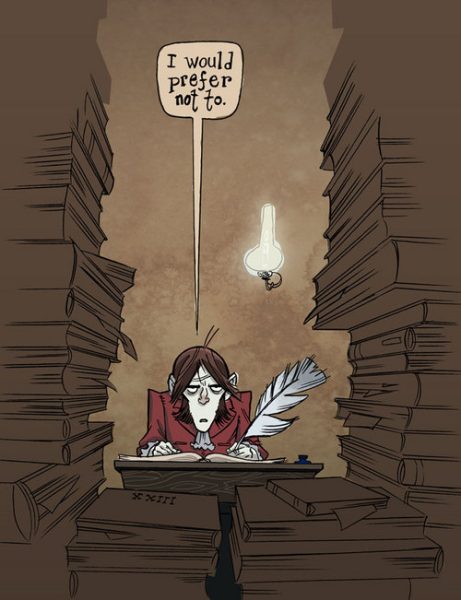
Another challenge is the complete erosion of any boundary between work and life. The Lawyer eventually discovers Bartleby is the sole occupant of the office at all times, even “at night … and on Sundays” (Melville). This shows that the titular character isn’t just a disengaged worker, he is a man with no home but his place of work. This total consumption by labor represents the capitalist logic where a worker’s value is only his work and output. Bartleby has become so identified by his function that, when he ceases to work, he has no other life. This represents the awful possibility that work can consume a person’s entire existence.
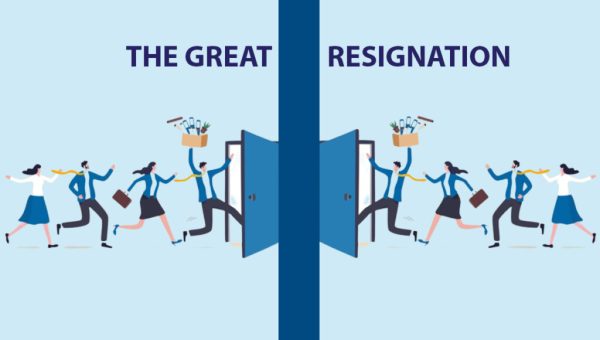
This 19th-century crisis bridges directly to the 21st-century phenomenon of the “Great Resignation.” While the Lawyer was puzzled by Bartleby’s behavior, viewing it as a strange anomaly, modern employers are finally being forced to recognize it as a systemic pattern. As Michelle Fox notes in CNBC’s “Employers Boost Mental Wellness Benefits amid the Great Resignation,” companies are now boosting wellness benefits specifically to combat high turnover. Fox lists expanded access to therapy, subscriptions to mental wellness apps, and more flexible paid time off as direct strategies to keep workers from walking away. If supporting employee mental health was non-existent in Melville’s day, where the solution was simply to fire or replace the “broken” worker altogether, it has now become a central and important corporate strategy. Employers have realized that the cost of recruiting and training new talent is far higher than the cost of maintaining the mental health of their current staff.
Furthermore, NPR’s “The Economics behind “Quiet Quitting” — and What We Should Call It Instead” allows us to argue that Bartleby was actually the original “quiet quitter.” In the article, former U.S. Secretary of Labor Marty Walsh gives his thoughts on “quiet quitting,” saying, “If you are an employer, you should catch on early enough that your employees aren’t satisfied, aren’t happy, and then there needs to be a dialogue, a conversation.” The term is meant to describe workers who are “just doing their jobs” and “not subscribing to the ‘work is life’ culture,” and we can compare it to Bartleby’s famous “I would prefer not to.” His passive resistance is essentially a 19th-century version of workers establishing boundaries and refusing to do work they feel is outside their core duties.
Another Michelle Fox article, “The Great Reshuffle: Companies Are Reinventing Rules as Employees Seek Remote Work, Flexible Hours and Life beyond Work,” directly contrasts Bartleby’s insistent living at work. The article shows that employees are reinventing rules to demand a “life beyond work.” Fox notes, “Employees who are satisfied with their company’s time and location flexibility are 2.6 times more likely to report being happy and 2.1 times more likely to recommend working at the company, according to LinkedIn’s data.” In the short story, Bartleby had no such option. By engaging in this reshuffle, the modern worker is actively trying to prevent Bartleby’s fate, demanding the physical and mental space that the scrivener was denied. They are leveraging their labor power to ensure that their home and their office do not become the same place, a luxury which Bartleby, sleeping on the office floor, sadly never had.
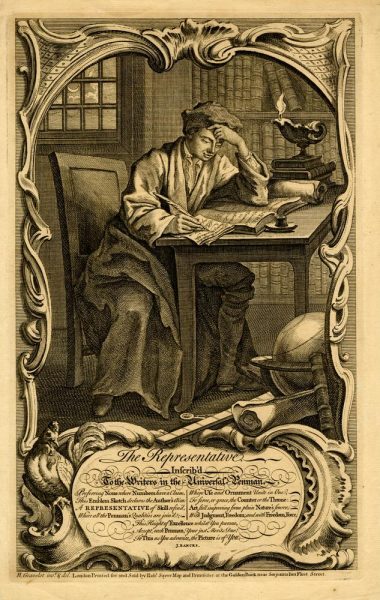
While the Lawyer in Melville’s story views his employee’s crisis as a confusing personal burden, modern day research has reframed this dilemma as an important organizational responsibility. In the short story, the Lawyer admits to feeling “a strange melancholy” for Bartleby, but he ultimately prioritizes his “prudence” and business reputation, thus choosing to abandon the poor scrivener rather than disrupt his office. This reaction highlights the 19th-century perspective that an employee’s deteriorating mental state was a private failing that an employer could outright ignore if it hurt the business. However, journalist Laura Beerman’s article “5 Strategies to Stretch Employer Mental Health Resources” demonstrates the modern workplace can no longer afford this detachment. Beerman highlights that companies are now expected to possess specific resources for mental wellness, and she details various strategies that treat employee mental health as a “logistical necessity” rather than a nice-to-have amenity. This approach signals a fundamental change in the workplace. Mental health is no longer a personal issue for the worker to ignore or solve alone, but it is essentially now a business strategy that requires active management and investment. By contrasting the Lawyer’s perceived helplessness with Beerman’s actionable strategies, we see the “problem” of Bartleby himself has evolved from a private moral battle into a widely recognized business challenge that demands closer attention.
Finally, with the primary source of Herman Melville’s story Bartleby, the Scrivener: A Story of Wall-Street and the four previous articles, we can understand that these modern workplace problems are not separate and isolated issues. The “quiet quitting” described by Rosalky and Selyukh in “The Economics behind ‘Quiet Quitting’” is, essentially, a widespread, 21st-century version of Bartleby’s quiet refusal. This push for boundaries is the very thing driving the “Great Reshuffle,” as employees are now collectively rejecting the “work-is-life” culture. In response, the corporate focus on mental wellness benefits described by Fox and Beerman’s strategies is the modern answer to the problem the Lawyer failed to solve.
The most disturbing consequence of the alienation explored in Melville’s story is not just Bartleby’s passive resistance, but the system’s final response. He isn’t saved, but instead arrested and imprisoned while starving to death. Near the end of the text, the Lawyer’s postscript details the “Dead Letter Office,” where Bartleby processed undeliverable mail. The scrivener himself is a “dead letter,” a message that 19th-century society had no way to read, deliver, or understand. The Lawyer’s final, helpless cry of “Ah Bartleby! Ah humanity!” is disturbing as it didn’t nor will offer any solution to Bartleby’s demise, and this echoes the same problems modern-day workplaces have with overworked or desensitized employees.
Bartleby, the Scrivener: A Story of Wall-Street is more than just a critique of the 19th-century work environment; it is an immensely influential and important allegory of the conflict between productivity and basic human needs. The most important thing to understand is that “quiet quitting,” “work/life balance,” and “workplace mental health” aren’t new problems. They are simply new terms for dilemmas that have existed for millennia. Rather than dismissing someone as disengaged or lazy, we could collectively see them as a symptom of the pre-existing system. Unlike the Lawyer who prioritized his business and even went as far as to move offices to escape Bartleby, the readers can learn to question the “walls” themselves. No one can fully understand what other people/workers are dealing with in their life, and that’s okay. The best we can do as a collective is to cultivate more active, empathic workplaces that see the humanity in workers, not just their functions and purposes.
Works Cited
Beerman, Laura. “5 Strategies to Stretch Employer Mental Health Resources.” Healthleadersmedia.com, 4 Apr. 2025, www.healthleadersmedia.com/payer/5-strategies-stretch-employer-mental-health-resources.
Fox, Michelle. “Employers Boost Mental Wellness Benefits amid the Great Resignation.” CNBC, 5 May 2022, www.cnbc.com/2022/05/05/employers-boost-mental-wellness-benefits-amid-the-great-resignation.html.
Fox, Michelle. “The Great Reshuffle: Companies Are Reinventing Rules as Employees Seek Remote Work, Flexible Hours and Life beyond Work.” CNBC, 4 Feb. 2022, www.cnbc.com/2022/02/04/companies-are-reinventing-rules-as-employees-seek-remote-work-and-flexible-hours.html.
Melville, Herman. Bartleby, the Scrivener: A Story of Wall-Street. Project Gutenberg, 1 Feb. 2004, www.gutenberg.org/ebooks/11231.
Rosalsky, Greg, and Alina Selyukh. “The Economics behind “Quiet Quitting” — and What We Should Call It Instead.” NPR, 13 Sept. 2022, www.npr.org/sections/money/2022/09/13/1122059402/the-economics-behind-quiet-quitting-and-what-we-should-call-it-instead.