
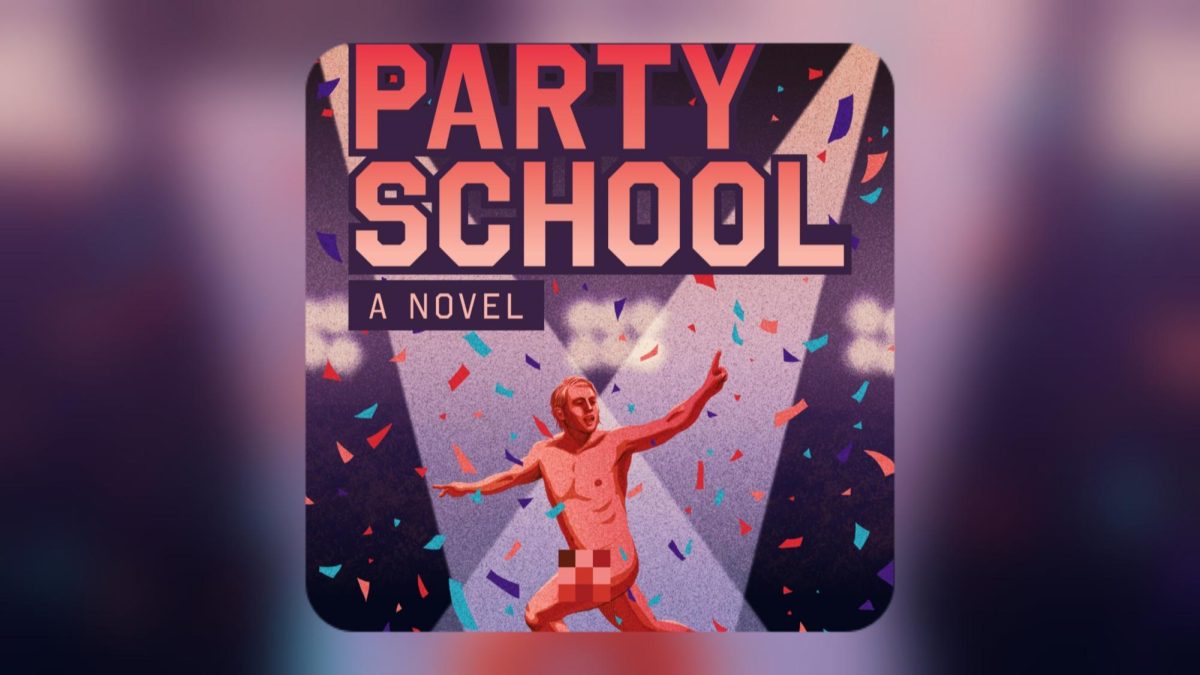
Released on April 26, 2022, by The Sager Group LLC, Jon Hart’s debut novel, Party School, is pitched as “Legally Blonde meets The Catcher in the Rye in this funny coming-of-age teen romance that reminds us that it doesn’t matter what college you go to, but what you make of the journey” (Amazon). And I have to say, it’s an accurate analogy.
Every year, as seniors finalize their commitments and the admissions frenzy peaks (thank goodness I didn’t have to deal with the latter), Hart’s novel serves as a timely deconstruction of the “it school” illusion. We live in an era where the pursuit of attending elite universities often overshadows actual education, and it drives students to compromise their integrity and learning for a prestige gap that barely exists anymore.
The story follows Dylan Mills, a self-proclaimed underachiever (and the streaker on the front cover), as he navigates his freshman year at the “party school,” North South University. To be completely honest, I found Dylan to be an extremely annoying protagonist at first. I first found it hard to believe an 18-year-old would act with such carelessness, but your main character has to grow in some way, right?
For example, Dylan’s first instinct is to ditch a professor’s introductory class simply because they assigned a few chapters of reading. He even complains, “If I were at an it school, I would expect that, but not here!” Sure, he didn’t have the fanciest upbringing or the same opportunities his high school classmates enjoyed, but that doesn’t excuse his unnecessary pouting for the first third of the book. Thankfully, he doesn’t stay that way throughout the entire novel.
Where the novel truly shines is in its authentic, grounded depiction of the college transition. Set between September 2022 and January 2023 (judging from the novel’s release date and the freshman T-shirts), the book captures the modern campus experience beautifully. There isn’t any huge Toklien-esque world-building with fantastic prose, but any teenager could easily visualize North South’s campus.
In fact, this was the first book I had ever read that explicitly mentioned “TikTok”. It goes to show how prevalent social media is nowadays, which makes characters like Professor Berkowitz completely justified in wanting face-to-face contact with his students (even if his syllabus policy is atrocious).
For me, one of the most authentic parts of the book was the freshman orientation hike in September. It captures that universal, unavoidable moment where everyone is required to introduce themselves to a fresh set of faces.
I personally don’t mind introducing myself to new people, but I know a lot of people who would prefer to take Andre’s route of simply refusing. Hart balances these awkward peer interactions with surprisingly supportive faculty, like Mr. Wells, the president of North South, who goes out of his way to ensure Dylan feels welcome at his new college.
And most importantly, I think the main message of “It’s not which college you attend, but what you make of it” is portrayed perfectly.
The climax hinges on a massive admissions scandal where students at the elite it schools are caught falsifying test scores and fabricating personal life experiences to get their foot in the door. It’s a compelling ethical dilemma, but sitting here in 2026, you have to wonder: Why bother?
Hart hits the nail on the head regarding the anxiety of college admissions, but it also highlights the sheer absurdity of the prestige chase.
If the quality of education at community colleges is fundamentally on par, and the transfer pathways to countless majors (and the aforementioned prestigious schools) are wide open, lying on an application becomes worse than unethical. I personally think it becomes entirely unnecessary.
Your character is not defined by the name of the institution on your acceptance letter, and your future career certainly doesn’t require compromising your ethics at such a young age (or ever).
The smart play isn’t faking your way into the Ivy League. It’s doing the honest, rigorous work exactly where you are, and letting the results speak for themselves. It’s not the end of the world.
In conclusion, Party School is a quick and fun read, and definitely worth checking out if you have three hours to kill.
A special thanks to Jon Hart for providing the Highland Piper with an electronic copy of the novel for this review.